
16. November 2026
|
#Tipps & Tricks
Types of wheelchairs: which one is right for you?
A wheelchair is more than a medical aid. It decides how freely you move through your everyday life: to work, to the shops, to friends on the third floor. But not all wheelchairs are the same. From the foldable standard model and the agile active wheelchair to the power wheelchair that climbs stairs, the differences are big.
In this comparison, you’ll find out which types of wheelchairs there are, who they suit, what they cost and who covers the costs in Germany, Austria and Switzerland.
Types of wheelchairs at a glance: the comparison table
| Wheelchair type | Drive | Suitable for | Guide price (DE)* |
|---|---|---|---|
| Standard wheelchair | Push rims or attendant | temporary use, short distances | from approx. €270 |
| Lightweight wheelchair | Push rims or attendant | frequent transport, travel | from approx. €290 |
| Active wheelchair | Push rims | long-term, independent use | approx. €500–3,000 |
| Multifunctional wheelchair | usually an attendant | long periods of sitting, limited trunk stability | from approx. €895 |
| Wheelchair with add-on drive | Push rims + electric motor | more range without changing chairs | depends on the system |
| Power wheelchair | Electric motor, joystick | little strength, long distances | up to approx. €10,000 and more |
| Stair-climbing power wheelchair | Electric motor, joystick, tracks | everyday life with stairs and steps | from €37,700 (Scewo GO with stair-climbing module) |
In short: If you can move under your own power, a manual wheelchair is a good fit (standard, lightweight or active wheelchair). If you lack the strength or travel longer distances, a power wheelchair is the better choice. And if stairs are a barrier in your everyday life, take a look at stair-climbing power wheelchairs.
*Guide values for orientation; prices vary depending on model and equipment.
Manual wheelchair: you set the pace
You move a manual wheelchair with your own muscle power using the push rims on the rear wheels, or an attendant pushes you. Manual wheelchairs are lighter, cheaper and don’t need a battery.
Standard wheelchair
The standard wheelchair is the classic from the medical supply store. It is foldable, robust and affordable, but at around 20 kg it is comparatively heavy. It is suitable if you only need a wheelchair temporarily, for example after surgery.
- Pros: affordable, robust, often available quickly
- Cons: heavy, hardly adjustable, not ideal for long-term use
Lightweight wheelchair
Its design is similar to the standard model, but thanks to its aluminium frame it is much lighter. It’s easier to lift into the car, and you need less strength to get around. Ideal for travel and day trips.
Active wheelchair
The active wheelchair (also called adaptive wheelchair) is made for people who use a wheelchair permanently and get around independently. It is precisely fitted to your body, light and agile. That makes it fast and saves energy, but it also takes practice and strength in your arms.
Multifunctional wheelchair (care wheelchair)
If you need support to sit upright, a multifunctional wheelchair is the right choice. A high back support, a headrest and adjustable seat tilt make long periods of sitting more comfortable. At around 30 kg it is heavy and is usually pushed by an attendant.
Wheelchair with add-on drive: the hybrid
Want to keep your manual wheelchair but go further? An electric add-on drive makes it possible. There are push-assist devices for attendants, wheel hub motors that boost your own propulsion, and power attachments that couple to the front of the wheelchair. This way, you combine the lightness of a manual wheelchair with electric support.
Power wheelchair: mobility without effort
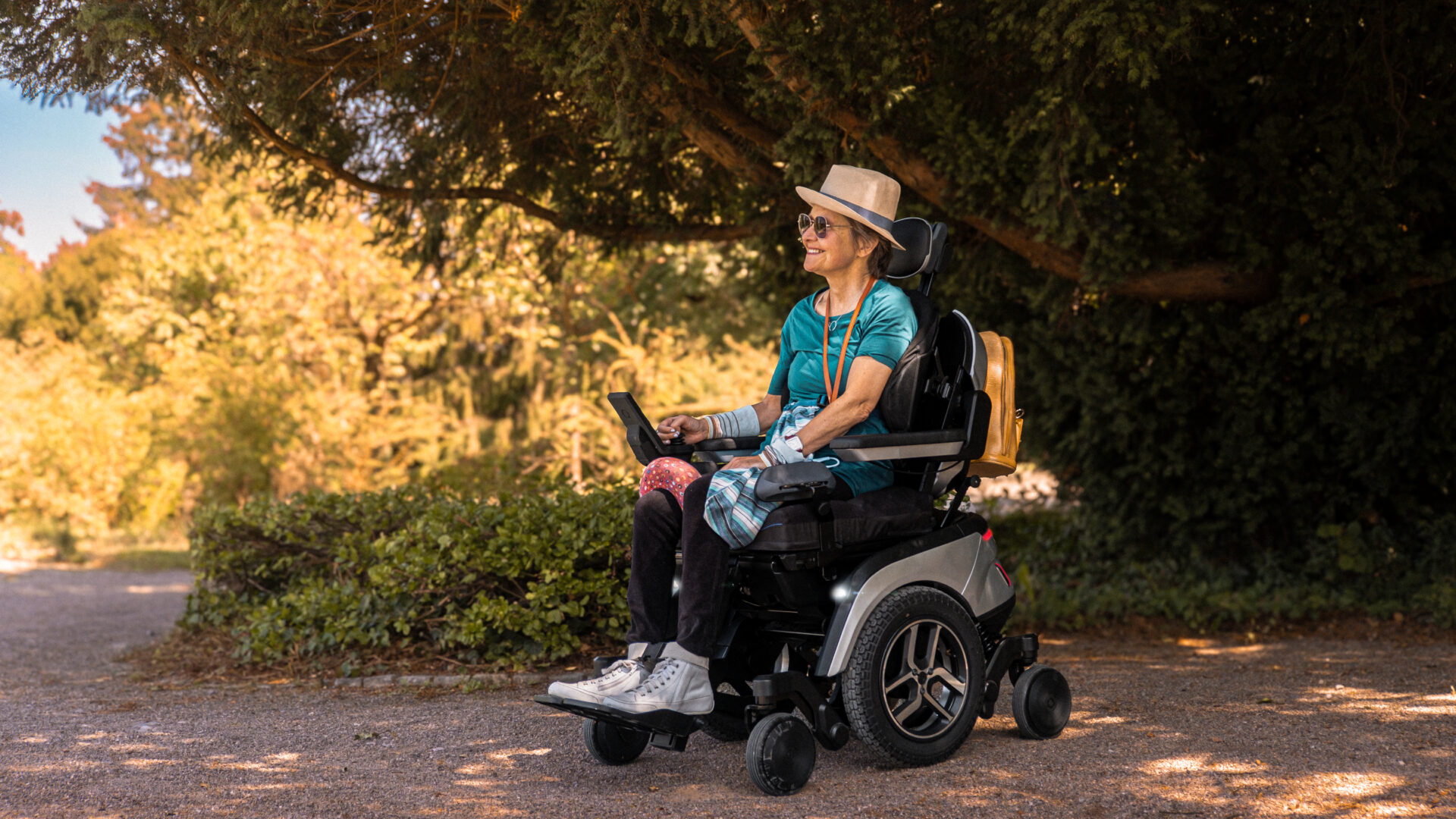
A power wheelchair is controlled with a joystick. It is suitable if you lack the strength for a manual wheelchair or travel longer distances every day. The key difference between models is the position of the drive wheels.
Rear-wheel drive
The large drive wheels are at the back, the small steering wheels at the front. This is the most common design. Rear-wheel drives stay on track even at higher speeds and are strong outdoors, but need more space to turn.
Front-wheel drive
Here, the drive wheels are at the front. A front-wheel drive handles kerbs and obstacles well and manoeuvres skilfully in tight spaces. At higher speeds, steering takes more finesse.
Mid-wheel drive
The drive wheels sit centrally under the seat, with smaller wheels providing support at the front and back. The wheelchair turns almost on the spot, which makes it especially agile at home, in the office and in lifts. One example is Scewo GO.
Power wheelchair or mobility scooter?
A mobility scooter is steered with handlebars and is mainly designed for outdoor use. You need good trunk stability to ride one. A power wheelchair is more compact, works just as well indoors as outdoors and can be adjusted individually to your body.
Stair-climbing wheelchair: when steps are no longer an obstacle
Most wheelchairs stop at the first step. Until now, that meant a ramp, a stairlift or help from others. A stair-climbing power wheelchair solves the problem directly. Scewo offers two models with different concepts. You’ll find a direct comparison under BRO and GO compared.
Scewo BRO: balances on two wheels, climbs on tracks
BRO drives self-balancing on two wheels. That makes it agile and brings you to eye level with the people you’re talking to. In front of a staircase, you switch to Stair Mode. BRO then climbs up or down on its tracks while the seat stays level.
- Stairs with an incline of 20° to 36° (36.4% to 72.6%)
- Single steps up to 200 mm high
- Straight stairs from 760 mm wide, L-shaped stairs with a landing from 1150 × 1150 mm (no spiral staircases)
- Real-world range: at least 25 km (20 Ah battery) or 35 km (30 Ah battery)
- Height adjustment: seat platform up to 890 mm high, ideal for conversations at eye level or reaching the top shelf
- User weight 40–120 kg
Scewo GO: six wheels, mid-wheel drive, stair climber as an upgrade
GO drives on six wheels with mid-wheel drive, so it feels familiar and intuitive. What makes it special: the stair-climbing module is optional. You can start with GO without the stair climber and retrofit the module if your needs change. GO has a modular design, can be configured individually and keeps driving even in a raised seat position.
- User weight 23–136 kg
- Base model from €18,500 (CHF 22,800), with stair-climbing module from €37,700 (CHF 42,200)
You’ll find all pricing details on our page Scewo prices for BRO and GO.
Which wheelchair is right for you? 5 questions to help you decide
- How long will you need the wheelchair? For a short time, a standard or rental wheelchair is often enough. For long-term use, a customised model is worth it.
- How much strength do you have in your arms and upper body? A lot of strength points to an active wheelchair, little strength to an add-on drive or a power wheelchair.
- Where do you get around? In tight spaces, agility counts (mid-wheel drive); outdoors, directional stability and range.
- Are there stairs in your everyday life? At home, at work, at friends’ places? Then take a look at a stair-climbing wheelchair.
- How do you transport the wheelchair? Foldable and light for the car, or with a ramp into a vehicle?
The best way to find the answer is a test drive. Try different models before you decide. You can test BRO and GO at home, free of charge and without obligation.
Wheelchair costs and funding in Germany, Austria and Switzerland
Germany: A wheelchair is a medical aid. With a medical prescription, your health insurance usually covers the costs, generally after approving a cost estimate from the medical supply store. Scewo BRO and Scewo GO each have their own aid number, which makes the application easier. You can read how this works for GO in our article on the Scewo GO aid number.
Austria: Here too, you need a medical prescription. Your health insurance provider, for example the ÖGK, decides on approval. A co-payment applies to medical aids; children under 15 are exempt.
Switzerland: Up to retirement age, the Swiss Disability Insurance (IV) covers the costs of medical aids under certain conditions, including repairs and maintenance. Scewo GO is listed with the IV. From retirement age, the Old-Age and Survivors’ Insurance (AHV) is responsible, with its own rules.
Whether the costs are covered in full or in part always depends on your individual needs and the decision of the funding body. More on this: Financing your Scewo wheelchair.
Frequently asked questions about wheelchairs
How much does a wheelchair cost?
A basic standard wheelchair costs from around €270, an active wheelchair between €500 and €3,000. Power wheelchairs are usually in the four-figure to low five-figure range, stair-climbing models above that.
Does health insurance pay for a power wheelchair?
Yes, if a manual wheelchair isn’t an option for you and a medical prescription confirms the medical necessity. The insurer reviews each application individually.
Can a wheelchair climb stairs?
Yes. Stair-climbing power wheelchairs such as Scewo BRO or Scewo GO with the stair-climbing module climb straight stairs without help from others.
Which wheelchair is the most agile?
For power wheelchairs, it’s mid-wheel drive; for manual wheelchairs, the active wheelchair.
What is the difference between a wheelchair and a care wheelchair?
A care wheelchair (multifunctional wheelchair) supports your back and head and is made for long periods of sitting. It is usually pushed by an attendant.