
7. October 2026
|
#Scewo Family
How Scewo GO came to life – Insights into its development
How do you develop a product that combines many functions in a compact space while adapting to a wide range of needs?
As Project Manager, Philipp Scherrer led the development of Scewo GO for series production – the world’s first wheelchair with a modular stair climber. In this interview, Philipp takes us behind the scenes and talks about challenges, teamwork and innovative concepts. A conversation about development and the small details that make a big difference in everyday life.
What is Scewo GO – and who was it developed for?
Philipp: Scewo GO is the world’s first modular stair-climbing wheelchair. There’s a clear idea behind it: mobility that works in everyday life – for everyone involved.
Can you remember the day a new product was first mentioned? What were your thoughts at the time?
Philipp: Yes, absolutely. About two years ago, the management team approached us with the idea for Scewo GO. My first reaction: Cool, we’re developing something new. But more than that – I immediately understood what it was about: GO was intended to be more modular and less complex, making a stair-climbing power wheelchair accessible to more people. Innovation doesn’t always mean more features, but the right features cleverly combined.
How do you turn customer feedback into concrete solutions?
Philipp: We built three prototypes before Scewo GO went into series production. That was the crucial part: these prototypes allowed us to collect real feedback from test drives, product demonstrations at dealers and therapists in clinics.
The feedback was often similar – especially when it came to ease of use and ergonomics. When five different users describe the same problem, it becomes a priority. Then we looked at it: Is it feasible to fix it? And how quickly? Not every piece of feedback leads to a major design change. Sometimes small adjustments are enough.
Without these iterative prototype rounds, we would have noticed what wasn’t working much later. This way, we could incorporate the changes early on – before it went into series production.
What tests did the GO prototypes have to pass before they could become a final product?
Philipp: We carried out extensive testing in-house and iterated quickly – functional tests, but also tests taken directly from the standards. That was important for identifying faults early.
But the critical part was the endurance testing. We can’t really carry that out in-house – it requires specialised and expensive test rigs. That was one of the reasons why the final tests at TÜV SÜD were so important. There, Scewo GO was subjected to loads over extended periods under controlled conditions to see whether the components held up, how it deformed and where wear occurred.
These are the tests that show whether a prototype can truly become a product – or whether further improvements are needed.
What is it like when mechanical engineering, industrial design, electronics and software work together on such a complex product? Were there any disagreements, and how do you resolve them?
Philipp: For components such as the main motor, all three teams have requirements. These are real challenges when different disciplines come together.
But the exciting thing is that these challenges also bring in new perspectives. When everyone is involved and works together on a solution, you step outside your comfort zone – and often find even better solutions that nobody would have found alone.
Decisions were always made as a team because everyone has the same goal: to build the best wheelchair in the world. When that’s your shared mission, it’s not about defending positions. It’s about solving problems together.
What detail will users probably barely notice visually, but clearly feel in everyday life?
Philipp: We use the latest brushless DC motors. You can’t see the technology, but you can clearly feel the difference when driving.
These motors enable much more precise control, which we call FlowDrive™. Instead of controlling only the torque, we control the speed. This means you have much more control during everyday driving. And when space is tight, such as going through a narrow doorway or moving around a small shop, you can make much finer adjustments. The wheelchair does exactly what you want – no more, no less.
A second detail is the seat’s adjustability. We worked hard to make the seat adapt better to your body. You can’t see it, but you feel it immediately: better ergonomics and greater comfort.
Which feature of Scewo GO are you particularly proud of?
Philipp: Honestly, I’m proud of GO as a whole. It’s a very compact wheelchair with many functions, and mechanics, electronics and software had to work well together to achieve that.
If I had to name one thing, it would be the compactness and modularity of the stair climber. The stair-climbing mechanism is elegantly designed, takes up no more space than necessary and has a modular construction.
What would you show someone first when they see the GO for the first time?
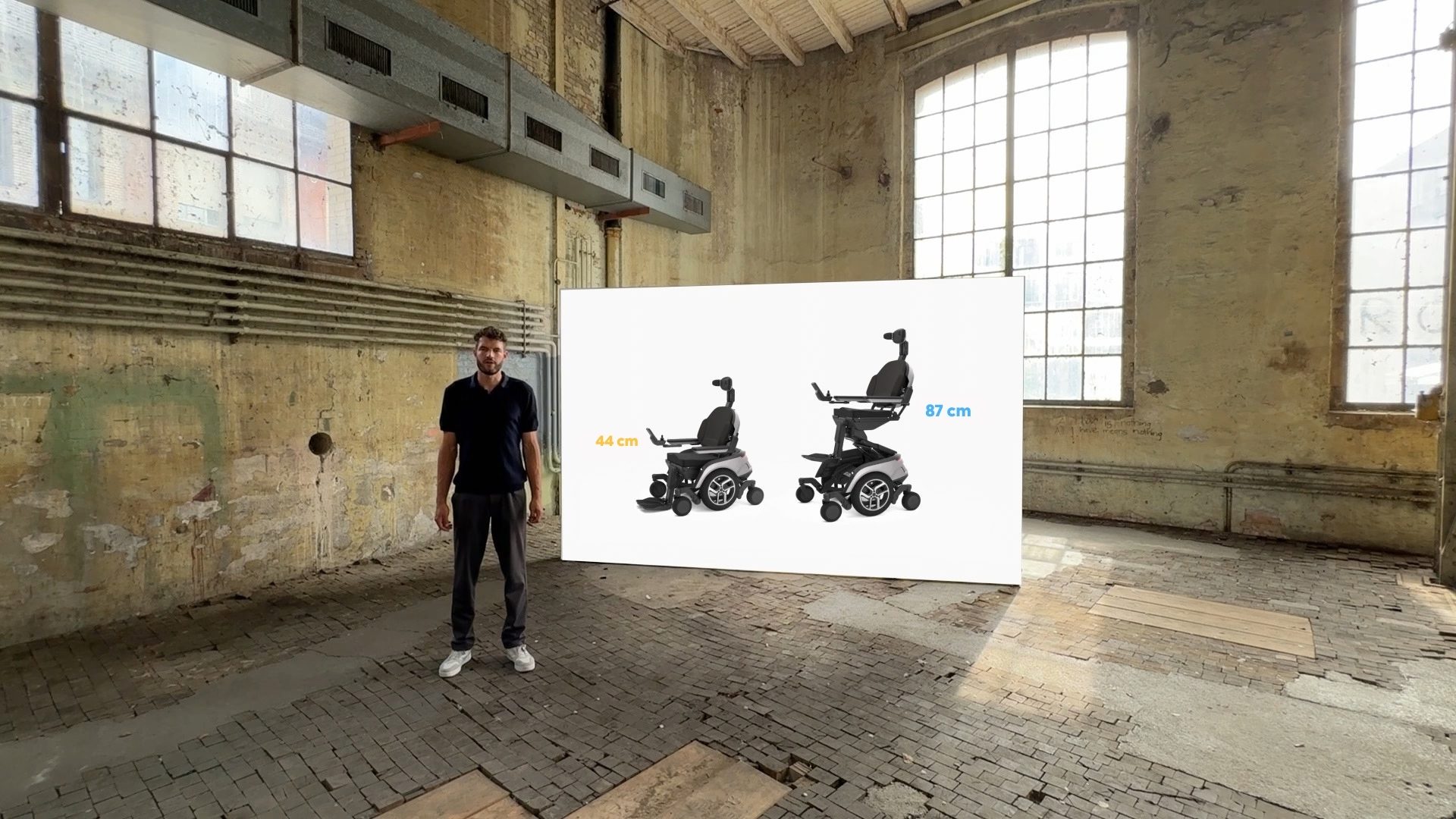
Philipp: The seat lift. With Scewo GO, you can raise the seat to a height of 87 centimetres. Even at my height of 1.96 metres, I can then communicate at eye level with the person in the wheelchair.
That’s the philosophy behind GO: meeting at eye level. Not having to look up to speak to someone. You only understand it once you get to experience it.
What are the biggest differences between Scewo BRO and Scewo GO?
Philipp: GO has a more modular design, and you can configure it more flexibly. It can navigate more complex stairs, and we’ve worked hard on ergonomic positioning and ease of adjustment.
How does it feel to see a finished product for the first time after working so hard on it?
Philipp: Relief, joy and a little pride, too. We worked on it for a year and a half, and now it’s here.
But what makes me happiest is that people are now receiving the GO. They have more freedom in everyday life. They can sit at eye level. They’re using a wheelchair that suits them. And soon, they’ll be able to climb stairs with it.
Want to discover more about Scewo GO?
Find out more about its technical specifications and unique features!