
27. June 2025
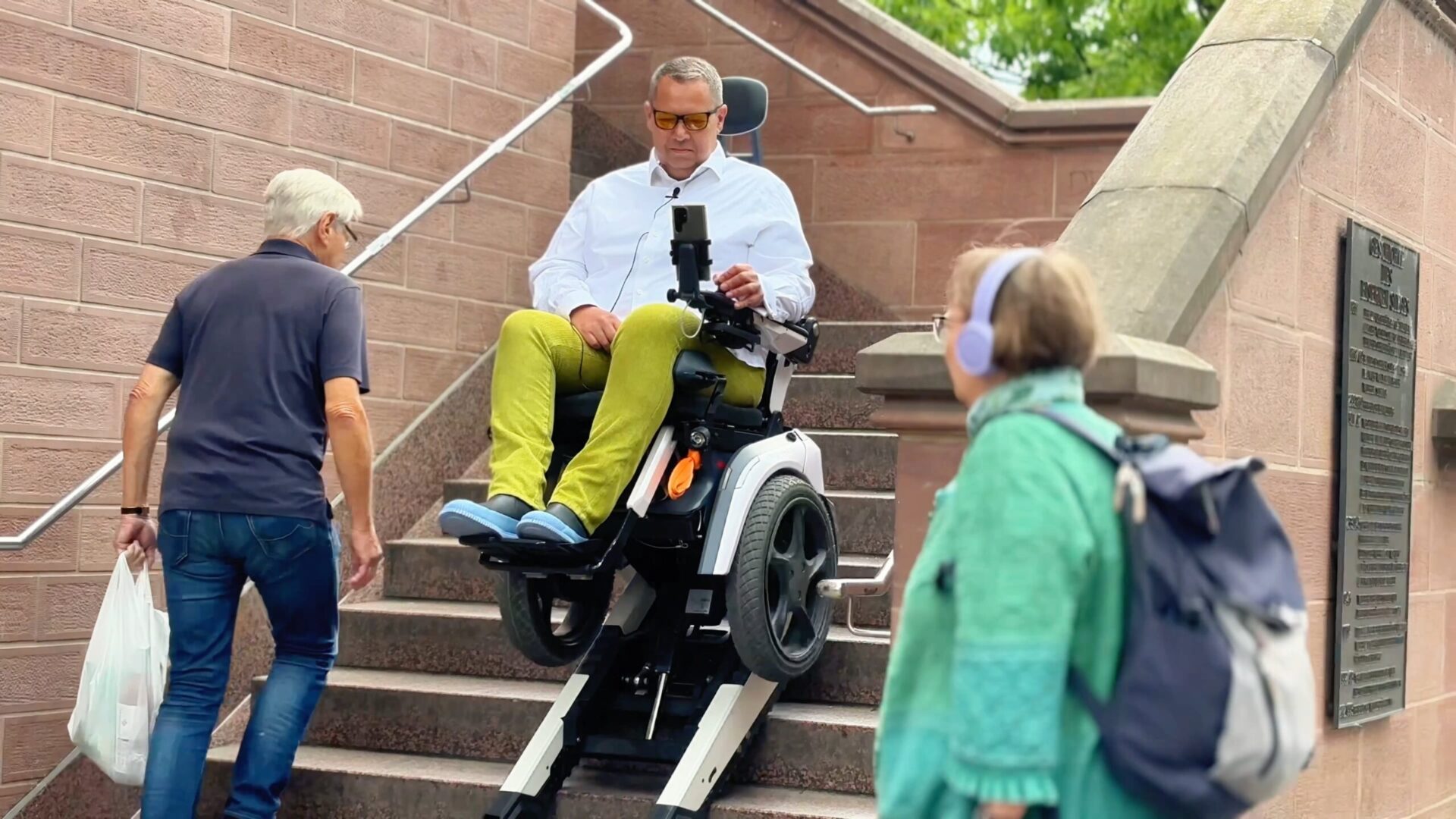
«It’s a truly amazing feeling to drive a wheelchair like this.»
When Daniel Fuks had a stroke a few years ago, his life changed from one moment to the next. By then, he had already built an impressive career. He had been successful in a wide range of roles – as a construction project manager, managing director and real estate agent. He was in the prime of his life when the diagnosis hit. Since then, the right side of his body has been paralysed. What followed was a long road back: rehab, a new professional direction and, above all, the question of how to manage everyday life with a new sense of his body.
Daniel has lived in Frankfurt for more than ten years. Today he is back in the thick of things, living independently and curious about everything that lies ahead. Besides his willpower, he owes his fresh start – both professionally and privately – to a very special companion: his Scewo BRO.
Step by step back into life
After his stroke, one thing quickly became clear to Daniel: giving up was not an option. He took further training, looked for new paths and came across Scewo BRO during his research. His own home has 18 steps that he has to manage every day. «I searched online for ways to overcome steps. BRO gave me the complete solution, because with it I can rediscover buildings and architecture, which are my passion, and keep working in my profession,» he sums up.
Today, despite the many barriers in everyday life, Daniel is back working actively as a construction and project manager. He explains: «That is the absolutely central issue in my job. Simply being able to get somewhere quickly, efficiently and safely. I can climb stairs in old buildings and new buildings, and I can even visit construction sites myself.»
Mobile despite a stroke
A stroke – medically also known as apoplexy or cerebrovascular accident – occurs when the blood supply to part of the brain is interrupted. The most common causes are blood clots (ischaemic stroke) or bleeding in the brain (haemorrhagic stroke). In both cases, brain cells die within a very short time – with potentially far-reaching consequences. In Germany, around 270,000 people have a stroke every year.
Especially after a stroke, it is crucial to quickly find solutions that provide not only physical support but also mental strength. An assistive device like Scewo BRO can help people gradually regain lost mobility and, above all, take part in life again.
(Source: Stiftung Deutsche Schlaganfall-Hilfe, in German)
Curiosity, connection, movement – what drives Daniel
Daniel loves being out and about. Travelling, discovering new places, exchanging ideas with other people – that is where he draws his energy from. With BRO at his side, every door is now literally open to him. «I always use BRO to get somewhere, whether near or far. By train, by car – no problem at all,» he explains. Whether visiting unfamiliar cities or in everyday life in Frankfurt, BRO takes him to places that would otherwise have remained inaccessible. Thanks to its high driving comfort and generous range, he can also cover longer distances with ease.
Meeting people at eye level matters a great deal to Daniel. In discussions, at talks or simply in conversation, BRO’s seat lift makes exactly that possible: «It lets me rise up, really look people in the face and talk and discuss with them.» It is in these moments that inclusion feels not just technical, but human.
Looking to the future with confidence
Daniel knows what it means to reorganise your life after a major turning point. «I can absolutely understand that people, especially after a serious illness or accident, have lost their self-confidence and their drive – that they simply no longer feel there is a goal worth working for.» Today he looks back calmly on what he has achieved – not in spite of, but with the right support: «Without BRO, I wouldn’t have taken certain steps. I have founded two companies and run them myself. That wouldn’t have worked at all without BRO.» For him, BRO has long been more than just an assistive device. As he puts it: «My BRO has become a member of the family.»
Funding through the German Federal Employment Agency
Daniel also owes all this to financial support from the German Federal Employment Agency (Bundesagentur für Arbeit). Beforehand, he had looked carefully into how the cost coverage process for BRO works as part of vocational rehabilitation. He then applied for cost coverage – successfully. The agency recognised BRO’s potential and how, as an assistive device, it helps make a return to work possible. «If you look at the total cost spread over five years, BRO is by no means expensive. On the contrary, it’s good value. Because I don’t need a stairlift, a car lift or any other additional solutions,» Daniel notes. His advice: «It never hurts to just give it a try.»