Accessible living: a life without obstacles.
Accessible living goes far beyond the needs of people with limited mobility. It is a housing concept that enables more comfort, safety and independence for all age groups and life situations.
In view of an increasingly ageing society and the growing focus on inclusion, accessible building and renovation are becoming more and more important. It is therefore worth taking a closer look at the many benefits and design possibilities of accessible living.
MEANING OF ACCESSIBLE
What does accessible really mean?
Often, “accessible” is simply equated with the absence of steps. In reality, however, it is about much more: namely the design of living spaces that are accessible and easy to use for all people without restrictions.
Movement areas: sufficient space for wheelchairs, walking aids or strollers.
Access points: threshold-free doors and access points, with a maximum height of 2 cm.
Usability: easily reachable switches, sockets and window handles.
Orientation: high-contrast design and good lighting.
Wet rooms: level-access showers and wheelchair-accessible washbasins.
The benefits for everyone.
Accessibility is not a special solution. It makes the home more comfortable, safer and more practical for everyday life for everyone:
Planning ahead for old age: an accessible home makes it possible to continue living in your own four walls for a long time, even when mobility decreases.
Safety: fewer tripping hazards, such as thresholds and loose rugs, mean fewer accidents – a benefit for children and seniors alike.
Comfort: moving heavy objects, carrying groceries or entering and leaving with a stroller is made significantly easier by wider doors and ramps.
Increase in value: properties that are future-proof and flexibly designed are more attractive on the market.
Accessible environment
How do I start my accessible project?
Whether it is a new build or a renovation, planning is the key:
Analysis of needs: which areas are most urgent? Often the bathroom and kitchen.
Get expert advice: architects, specialized tradespeople and housing advice centers know the DIN standards, for example DIN 18040 in Germany, and the funding options.
Check financing: there are various state subsidies, loans, for example KfW in Germany, or grants from long-term care insurance funds if a recognized care level exists.
FAQ: frequently asked questions about accessible living
1. What is the difference between accessible and wheelchair-friendly?
Accessible means usable by everyone without particular difficulty, for example wide paths and no thresholds.
Wheelchair-friendly is a stricter accessibility requirement that takes specific dimensions for wheelchair users into account, for example large turning areas and wheelchair-accessible kitchens.
2. Which dimensions are important for doors in accessible building?
The width of a door should be at least 80 cm, and even 90 cm for wheelchair-friendly apartments. Thresholds should be a maximum of 2 cm high.
3. Is there state funding for renovation?
Yes. In Germany, KfW Bank, for example program 159 “Altersgerecht Umbauen”, and in many cases the long-term care insurance funds, if a recognized care level exists, offer grants or low-interest loans. Also inform yourself about state-specific programs.
4. Does a bathroom always have to be completely rebuilt?
Not necessarily. Often, smaller measures such as installing a level-access shower, installing grab rails or a wheelchair-accessible washbasin are enough to achieve a major improvement in accessibility.
5. How can I design my kitchen to be accessible?
Important elements are wheelchair-accessible worktops, height-adjustable elements, easy-to-use pull-outs instead of lower cabinets and ovens or dishwashers installed at a higher level to avoid bending down.
6. How expensive is accessible building in comparison?
A new build that is planned to be accessible from the start is often only slightly more expensive, with estimated additional costs of 1–3% compared to a conventional build. The costs of later renovations are significantly higher, but can be reduced through funding.
7. Are all new builds in Germany automatically accessible?
No. The building regulations of the federal states specify that publicly accessible buildings as well as a portion of apartments in multi-family buildings must be accessible. For single-family houses, this general obligation does not exist, but it is strongly recommended.
Alternatives to accessible living
How Scewo BRO overcomes barriers.
Accessible living is a decisive step toward independence and quality of life. But not every property can be fully renovated. Especially in old buildings, narrow city apartments or listed buildings, structural adaptations are often only possible to a limited extent or are associated with very high costs. This is exactly where innovative solutions come into play that do not remove barriers, but overcome them intelligently.
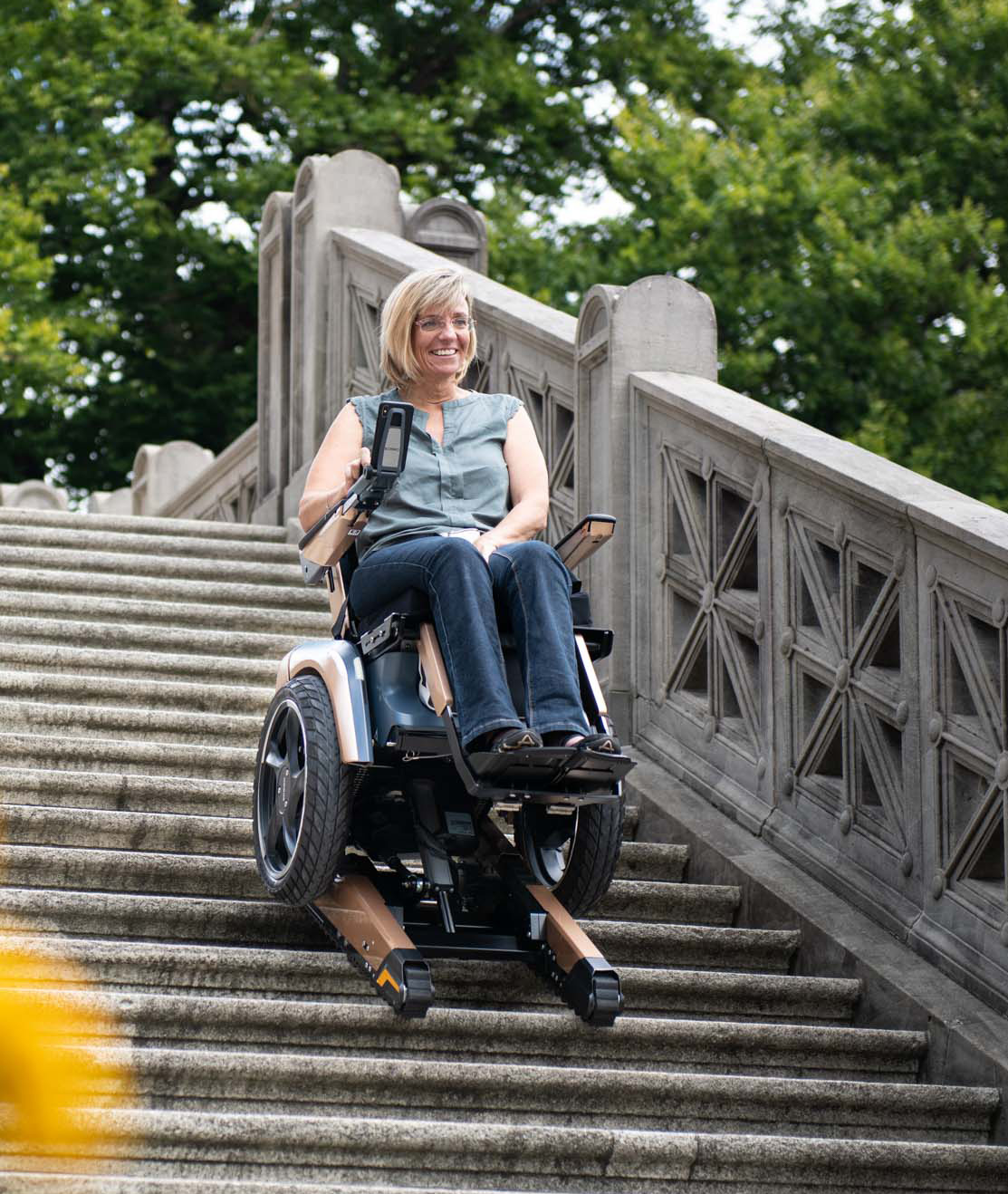
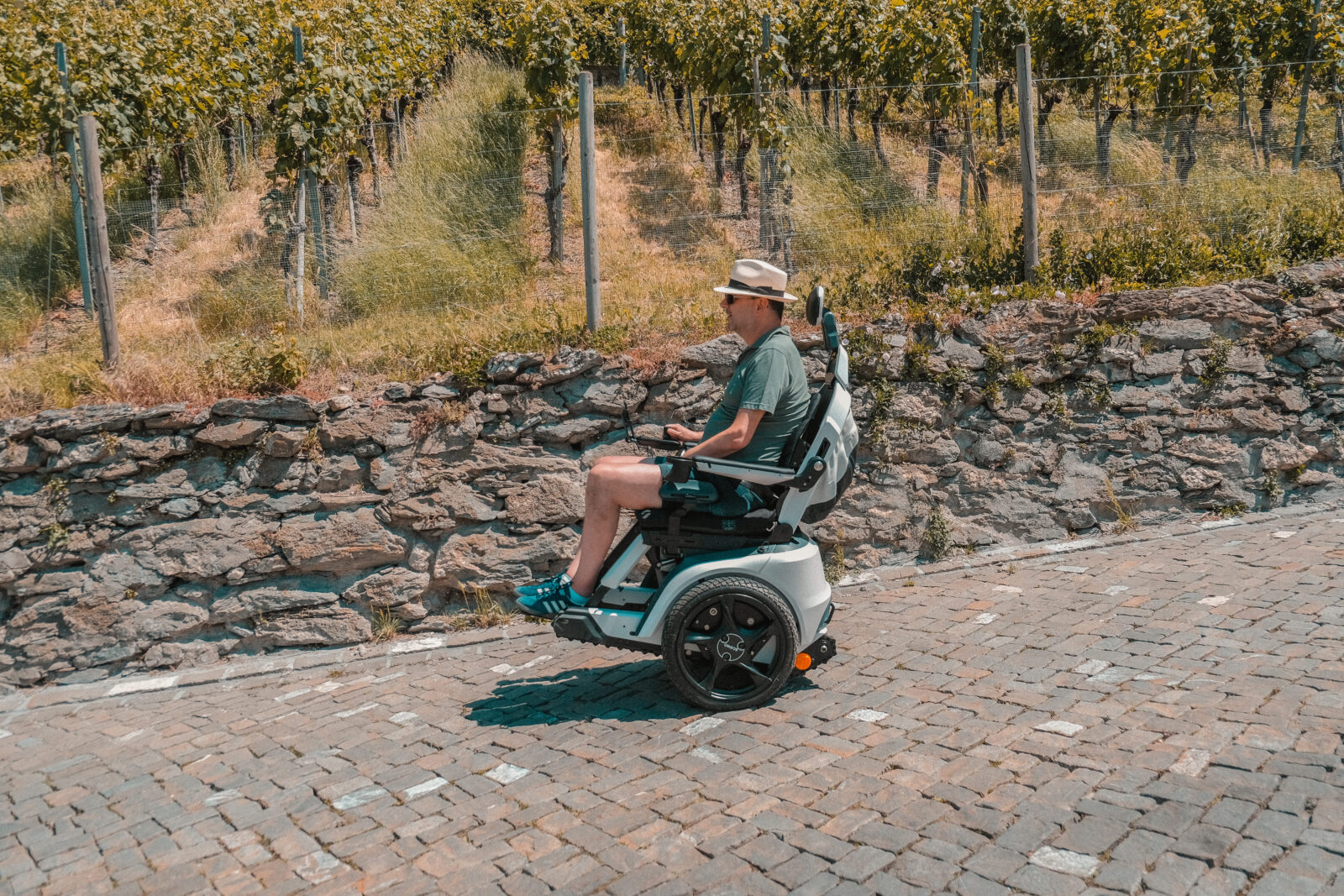
This is where we come in: the stair-climbing wheelchair Scewo BRO. Developed in Switzerland, this innovative assistive device combines the functionality of a classic power wheelchair with the ability to overcome stairs independently.
Important: technological solutions like the Scewo BRO are not intended to replace accessible building, but to meaningfully complement it. They offer an additional option when classic measures are not sufficient or cannot be implemented.
Free testdrive